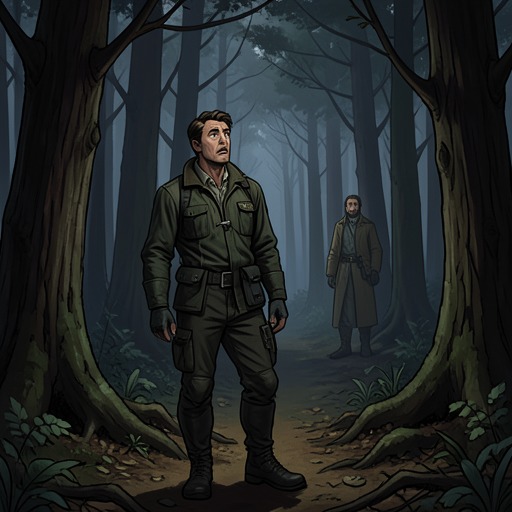
Grove of Death
Heart of DarknessThe Grove of Death is the place where laborers sickened by the colonial work system are abandoned to die, a pocket of shade set against the continuing noise and machinery of extraction. Marlow’s account makes the grove both a physical refuge from the blinding sun and a scene of exposure: here the human consequences of labor contracts and administrative efficiency lie in plain sight, close to the station that records business as usual.
Setting and Approach
Marlow reaches the grove after descending a hillside, where the landscape already bears marks of activity without any clear purpose. A vast artificial hole has been dug into the slope, though he cannot identify what it is for; nearby, imported drainage pipes lie tumbled in a narrow ravine, every one broken. The damage reads less like useful construction than waste. These details prepare for a place where work is visible but its claims of purpose are difficult to trust.
Under the trees, the sound of nearby rapids rushes without pause through an otherwise still scene. Marlow describes the noise as if the tearing movement of the earth had become audible. The grove’s shade offers relief from the sun, but the quiet vegetation and steady rushing sound give the space a severe, enclosed character. A blast from a mine on the cliff brings a slight shudder to the ground. Work is still under way close by; the grove is not outside the operation, but alongside it.
The Abandoned Laborers
Between the trees, Marlow sees people crouched or lying against trunks and on the earth, their bodies partly visible and partly lost in dim light. He first registers them as shapes in attitudes of pain, exhaustion, and despair, then understands that they are dying slowly. They are neither enemies nor criminals. Brought from different parts of the coast under time contracts, they have been placed in surroundings and given food unfamiliar to them; after they sicken and become unable to work efficiently, they are allowed to crawl away and rest. Their apparent freedom in the grove is inseparable from the circumstances that have left them there, nearly starving and without care.
A young man lies near Marlow’s hand, so thin that his bones seem to define his body. His eyelids lift and his sunken eyes turn toward Marlow before their faint light dies away. Marlow offers him a ship’s biscuit. The young man’s fingers close slowly around it, but he makes no other movement. Around his neck is a short piece of white worsted, conspicuous against his dark skin. Marlow cannot determine whether it is a badge, ornament, charm, or something without any such meaning; the thread remains an unexplained object amid a scene in which even the small signs of individual life are difficult to interpret.
Nearby, two more figures sit with their legs drawn up, one staring into nothing and another resting his forehead as if overcome by weariness. Others lie scattered in contorted positions. One laborer manages to rise onto his hands and knees and crawl toward the river. He drinks from his hand, sits in the sunlight with his shins crossed, and eventually lets his head fall onto his chest. The movement is brief and practical, but it shows how thoroughly ordinary acts of survival have been reduced to effort.
Work and the Station
The grove’s proximity to the station makes its abandonment part of the same working landscape as the company’s business. When Marlow later looks from the station doorway, the treetops are visible fifty feet below. In the foreground, one agent lies flushed and insensible, while another bends over the books making entries of transactions described as correct. The contrast does not require the grove to be hidden far away: the dying laborers are close enough to remain in view, even as bookkeeping proceeds.
The mine blast and the continued work make the scene more than a record of individual illness. Laborers are brought in under contracts, weakened by unfamiliar conditions, and discarded when they can no longer serve the work. The nearby station provides an image of the order that accompanies this process: accounts can be kept correctly while the people whose labor sustains the operation lie among the trees. The distance between desk and grove is measured in feet, not in moral or administrative awareness.
Narrative Significance
Marlow’s movement into the grove slows the journey from descriptions of damaged infrastructure to close attention to bodies and gestures. The broken pipes, the unmoving figures, the biscuit held in a weak hand, and the worker crawling to drink give material form to the costs that abstract accounts of work conceal. The grove is not simply an emblem of death; it is a specific place created by a sequence of conditions, from transportation and unfamiliar food to sickness, lost efficiency, and abandonment.
Its setting also sharpens the contrast between apparent order and actual consequence. The station’s ledgers continue to register correct transactions, while the grove holds those whom the system has made unable to work. By placing the bodies beneath the station’s sightline and the mine’s continuing activity, the narrative makes the grove a material counter-record: the human reality that formal bookkeeping does not represent. Its shade shelters the laborers only in the narrowest sense, as they wait there without food, treatment, or meaningful protection.